> For the complete documentation index, see [llms.txt](https://guides.privatesolution.org/llms.txt). Markdown versions of documentation pages are available by appending `.md` to page URLs; this page is available as [Markdown](https://guides.privatesolution.org/dma-card-setup/speedtest.md).
# Speedtest
Run this once after the card and 2nd PC are connected. It confirms the card works — before you touch any game software.
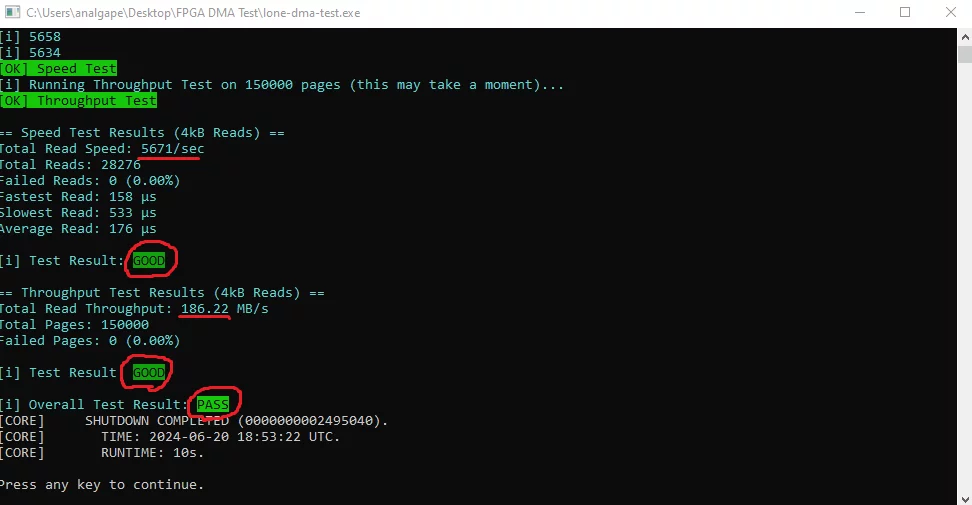
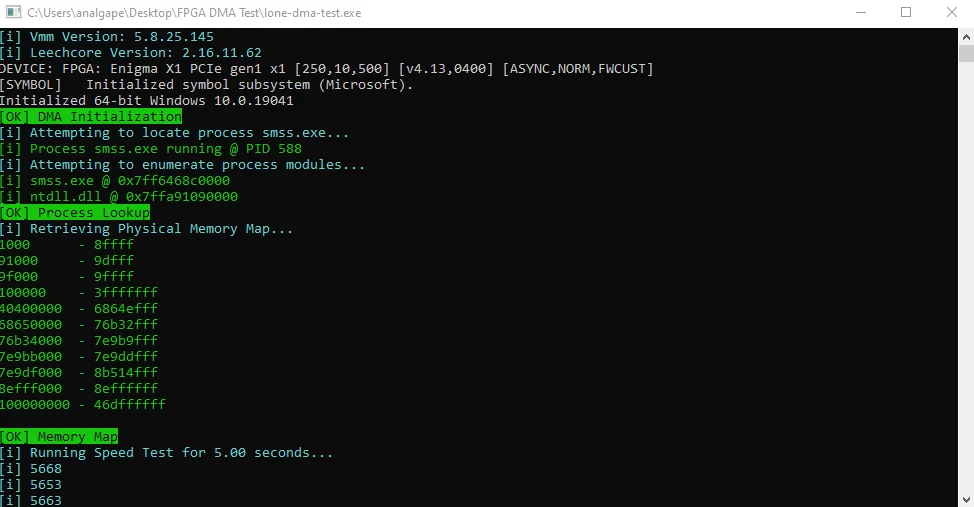
Download: lonetest.zip contains the third-party Lone DMA Test utility and its supporting files. Extract the full archive before use. This upload has not been independently security-verified; only test systems you own or are authorized to access. Example screenshots below are from Phoenix Labs (); tool credit: Lone EFT / Lone DMA. Example results are illustrative, not a guaranteed speed.
{% file src="/files/OqSS9TtfoO3zNoBeBVCg" %}
## Why you run it
The speedtest reads the main PC's memory from the 2nd PC and shows you how fast the card is talking. If the number looks right, your hardware is done and you can move on to playing.
## Steps
1. **Turn the main PC on** and let Windows load normally.
2. **On the 2nd PC,** open the toolset that came with your order.
3. **Go to the Speedtest tab** (or run the speedtest tool).
4. **Click Start** and watch the read speed.
## What a good result looks like
* The read speed is stable — not jumping to zero
* The tool reports **no errors**
If you see errors or the speed is 0, it is almost always the USB cable or slot. Try a different USB port on the 2nd PC, or a different PCIe slot, and run again.
## After the test passes
* Hardware setup: **done**
* Next: load your software on the 2nd PC — or open your ticket and we will walk you through the first run.
{% hint style="info" %}
Speedtest not passing? Do not worry — 9 out of 10 times it is a cable or slot. Still stuck after trying that? Open a ticket and a real person will debug it with you.
{% endhint %}
---
# Agent Instructions
This documentation is published with GitBook. GitBook is the documentation platform designed so that both humans and AI agents can read, navigate, and reason over technical content effectively. Learn more at gitbook.com.
## Querying This Documentation
If you need additional information that is not directly available in this page, you can query the documentation by asking a question.
Perform an HTTP GET request on the following URL with the `ask` and `goal` query parameters:
```
GET https://guides.privatesolution.org/dma-card-setup/speedtest.md?ask=&goal=
```
`ask` is the immediate question: it should be specific, self-contained, and written in natural language.
`goal` is what the user is ultimately trying to achieve, the reason they need the answer. Sharing it helps GitBook give you a better, more relevant answer. A goal is most helpful when it describes the outcome the user wants rather than restating the question. For example, with `ask=how do I create an API token`, a goal like `automate deployments from our CI pipeline` lets GitBook tailor the answer to that use case.
The response will contain a direct answer to the question and relevant excerpts and sources from the documentation.
Use this mechanism when the answer is not explicitly present in the current page, you need clarification or additional context, or you want to retrieve related documentation sections.